


☺
Musica
Scritto da: Mattia
> Un pezzo composto da Mendelssohn, il tizio che faceva esperimenti genetici sui piselli.
>
> 1838, 29 anni.
>
> Mendelssohn - MWV Q26 - Violin Sonata in F Major (1838):
> I. Allegro vivace 00:00
> II. Adagio 11:02
> III. Assai vivace 18:39
>
>
Il secondo movimento è sublime.
Il terzo epico.
È proprio vero che Mendelssohn sta alla musica come i bambini biondi stanno a sto cazzo!
**Modificato dall'autore il 12.02.2024 02:42**
☺
Musica
Qui sotto la colonna sonora del film A.I. - Intelligenza Artificiale. Musica composta da John Williams.
Il video, che contiene una selezione delle parti migliori della suite, è strutturato come segue:
00:00 The Reunion [tema principale]
07:49 Abandoned in the Woods
09:53 The Moon Rising
13:23 Man-Hatten
18:43 End Credits - Where Dreams Are Born [ripresa finale del tema principale con climax]
Il video, che contiene una selezione delle parti migliori della suite, è strutturato come segue:
00:00 The Reunion [tema principale]
07:49 Abandoned in the Woods
09:53 The Moon Rising
13:23 Man-Hatten
18:43 End Credits - Where Dreams Are Born [ripresa finale del tema principale con climax]
☺
Musica
Un pezzo composto da Mendelssohn, il tizio che faceva esperimenti genetici sui piselli.
1838, 29 anni.
Mendelssohn - MWV Q26 - Violin Sonata in F Major (1838):
I. Allegro vivace 00:00
II. Adagio 11:02
III. Assai vivace 18:39
Mattia: "Conosci Mendelssohn?"
Sorella di Mattia: "È quello dei piselli?"
Mattia: "No, quello è Mendel! "
1838, 29 anni.
Mendelssohn - MWV Q26 - Violin Sonata in F Major (1838):
I. Allegro vivace 00:00
II. Adagio 11:02
III. Assai vivace 18:39
Mattia: "Conosci Mendelssohn?"
Sorella di Mattia: "È quello dei piselli?"
Mattia: "No, quello è Mendel!
"
☺
Musica
Il Concerto per Piano No. 3 di Beethoven, da egli composto nel 1800 all'età di 29 anni, è una gran figata!
Niente cazzate! Premete su play o siete gay!
Beethoven - Op. 37 - Piano Concerto No. 3 in C minor (1800):
00:00 I. Allegro con brio
16:43 II. Largo
26:37 III. Rondo. Allegro - Presto
Niente cazzate! Premete su play o siete gay!
Beethoven - Op. 37 - Piano Concerto No. 3 in C minor (1800):
00:00 I. Allegro con brio
16:43 II. Largo
26:37 III. Rondo. Allegro - Presto
☺
Musica
https://forum.termometropolitico.it/858371-festiva... 
In questi giorni è iniziato il festival di Sanremo 2024 e visto che molti stanno dicendo politicamente la loro su questo evento vorrei dire anche io la mia.
Ebbene, quello che sostengo io è che il Festival di Sanremo debba essere privatizzato e che se nessun privato vuole farsene carico deve essere chiuso.
Questa mia posizione non ha nulla a che fare con il fatto che Amadeus ha cantato "Bella ciao" insieme a Mengoni proprio il giorno dell'apertura, cosa che sembra preoccupare molto i neofascisti. Anzi, io penso che in uno stato civile i poliziotti ti fermerebbero per strada invitandoti a cantare "Bella ciao" e che il 25 aprile la polizia dovrebbe suonarti il campanello per ricordarti che devi uscire a festeggiare la liberazione del paese dai criminali fascisti.
Il punto è che, dal punto di vista del Partito, le televisione pubblica ha lo scopo di promuovere la cultura colta... ed è solo questo, fondamentalmente, a giustificare l'esistenza di una televisione pubblica. Il concetto dovrebbe essere "Visto che su Mediaset ci sono programmi spazzatura, allora noi ci facciamo la TV pubblica che propone programmi di più alta cultura".
Ora, ricordo che quando Fazio levò le tende ci fu la polemica che il suo programma faceva fare molti utili alla Rai, ma questa è una prospettiva sbagliata, secondo il Partito. Infatti i servizi pubblici non devono avere lo scopo di fare utili, ma devono avere degli scopi sociali.... nel caso della TV, quello di promuovere la cultura colta.
Se no a sto punto facciamo un Grande Fratello anche sulla Rai così sicuramente gli utili non mancheranno. Mettiamo un po' di programmi trash tette e culi come Mediaset e siamo apposto, perché no?
Una volta accettato questo presupposto, uno dovrebbe chiedersi in che modo Sanremo promuoverebbe la cultura.
Cerchiamo di parlarci chiaro: Sanremo non fa nulla di diverso da quello che fanno le classiche radio ipercommerciali destinate al consumo di massa: pompa canzonette senza nessun particolare merito artistico e la cui qualità è molto semplicemente quella di essere di facile consumo.
Mettiamola in questa maniera: se ci fosse un libro di divulgazione scientifica serio da un lato, e un libretto che spiega la fisica coi fumetti dall'altro, Sanremo ti porterebbe un fumetto di Topolino
Ebbene si, quello che fa Sanremo con la musica è equivalente a un ipotetico Festival delle Letteratura che propone i fumetti di Topolino!!!
Non ha senso quindi che Sanremo continui a stare sotto il servizio pubblico. Che se lo prenda Mediaset, così possono anche far cantare Mario Giordano, visto che ha una bella voce!
In quanto invece alla Rai, se proprio proprio si vuole fare un festival musicale, che si faccia un evento annuale dedicato alla musica classica.
Ci potrebbe essere una gara per i compositori da un lato (quindi musica classica contemporanea), e una gara per interpreti dall'altro (quindi musica classica di diverse ere).
Prima che @Gianluca C.venga a spaventarvi mettendo un esempio di musica classica contemporanea stereotipata tipo quella di Scelsi, faccio presente che fortunatamente ci sono ancora compositori che fanno musica melodica.
Una delle migliori cose che ho sentito, ad esempio, è questa fantasia per piano e orchestra di Arash Safaian, basata sul primo movimento della Sonata al Chiaro di Luna di Beethoven.
Oppure il Concerto per Flauto di Christopher Rouse, il cui terzo movimento (vedi video sotto) è dedicato a un bambino di 3 anni torturato e ucciso in USA.
Ci sono poi anche le colonne sonore dei film, dove c'è musica classica contemporanea e melodica in abbondanza... chissà, magari verrebbe anche John Williams a suonare nel nuovo Festival di Musica Classica della Rai!
Insomma, la musica d'avanguardia è solo quella più controversa, ma non pensate che tutta la musica classica contemporanea sia d'avanguardia: c'è ancora spazio per le belle melodie!
**Modificato dall'autore il 08.02.2024 18:11**
☺
Musica
Probabilmente composta da Mozart nel 1766-1769, all'età di 10-13 anni.
Il primo movimento è fantastico!
Mozart - K. 76 - Symphony 43 in F major (1766-1769?):
00:00 I. Allegro maestoso, 4/4
03:35 II. Andante, 3/4
07:58 III. Menuetto, 3/4
11:27 IV. Allegro, 2/4
**Modificato dall'autore il 06.02.2024 17:06**
Il primo movimento è fantastico!
Mozart - K. 76 - Symphony 43 in F major (1766-1769?):
00:00 I. Allegro maestoso, 4/4
03:35 II. Andante, 3/4
07:58 III. Menuetto, 3/4
11:27 IV. Allegro, 2/4
**Modificato dall'autore il 06.02.2024 17:06**
☺
Musica
Ad Alessandrox piacerà sicuramente questa celebre sinfonia del compositore russo Vasily Kalinnikov.
Un altro di quei tanti compositori promettenti che sono morti troppo presto!
Composta nel 1895-1897, quando il compositore aveva 29-31 anni.
Vasily Kalinnikov - Symphony No.2 in A-major (1895-1897):
I. Moderato - Allegro ma non troppo [00:00]
II. Andante cantabile [10:13]
III. Allegro scherzando [18:20]
IV. Andante cantabile - Allegro vivo [26:26]
☺
Musica
Fabri Fibra spinge rap in vena, io invece vi spingo nel culo questo pezzo concertante di Mendelssohn per piano e orchestra.
Composto nel 1838, quando Mendelssohn aveva 29 anni.
Mendelssohn - Op. 43 - Serenade and Allegro giocoso in B Minor (1838)
**Modificato dall'autore il 04.02.2024 15:07**
Composto nel 1838, quando Mendelssohn aveva 29 anni.
Mendelssohn - Op. 43 - Serenade and Allegro giocoso in B Minor (1838)
**Modificato dall'autore il 04.02.2024 15:07**
☺
Musica
I risultati sono:
- Il Gladiatore e Il Patriota: 3 voti
- La tigre e il dragone: 2 voti
- Chocolat: 1 voto
- Malèna: 0 voti
Il Gladiatore e Il Patriota si qualificano quindi per la seconda parte di questa competizione.
- Il Gladiatore e Il Patriota: 3 voti
- La tigre e il dragone: 2 voti
- Chocolat: 1 voto
- Malèna: 0 voti
Il Gladiatore e Il Patriota si qualificano quindi per la seconda parte di questa competizione.
Tua madre succhia cazzi all'inferno
Ad
http://www.vatican.va/content/vatican/en.html
Nessuno ci crede per poi affogare nella realtà subito dopo
☺
Musica
Scritto da un utente in Reddit riguardo all'usare termini come "musica colta" o "art music" come sinonimi di "musica classica":  https://www.reddit.com/r/classicalmusic/comments/1...
----------------------
Come qualcuno che sta studiando per diventare (si spera!) un etnomusicologo, ho un apprezzamento per tutti gli stili musicali del mondo, dal rock, al rap, al gamelan, al canto di gola, al taiko, al raga e altro ancora. Tuttavia, un genere (classificazione, suppongo), anche se ha il mio amore, e lo ascolto regolarmente, ha un nome che mi infastidisce molto: "Musica d'arte". Il nome sembra avere una sorta di ipocrisia e un peso che sembra quasi sprezzante nei confronti di un intero mondo della musica.
Durante la mia formazione musicale all'università, non avevo mai avuto un professore che usasse questo termine (per fortuna. Avrei metaforicamente stretto la mano se un professore avesse effettivamente sostenuto che la musica classica in stile europeo era l'unica vera "arte"). Mi sono imbattuto per la prima volta in questo termine su Internet solo poche settimane fa e mi sono subito sentito molto a disagio con la sua esistenza e il suo utilizzo. E dopo aver letto storie sull'uso dei termini nel mondo accademico, mi sono sentita ancora più a disagio. Sono state condivise alcune storie di insegnanti di musica che hanno dato voti insufficienti, o addirittura hanno buttato via documenti che osavano concentrarsi su qualsiasi genere musicale che non fosse all'altezza della definizione di "arte" dell'insegnante.
Dovrebbe essere un termine usato dal mondo accademico moderno? O dovrebbe essere ritirato?
Trovo ridicola l'idea che nessuno al mondo abbia fatto musica d'arte prima che l'Europa inventasse il genere, e l'idea che le tradizioni popolari di tutto il mondo non siano vera "musica d'arte" sia francamente molto sprezzante e, a seconda della tradizione, potenzialmente xenofoba.
Tieni presente che non ho necessariamente contro nessuno l'uso di questo termine, e nemmeno la difesa dell'uso di questo termine, quindi non pensare che cercherò di discutere con le risposte di qualcuno in modo meschino (supponendo che tu stesso sia rispettoso di me e delle tradizioni musicali che stai citando). Tuttavia, se non sono d'accordo, probabilmente respingerò il tuo modo di pensare in modo costruttivo.
----------------------
La mia risposta:https://www.reddit.com/r/classicalmusic/comments/1...
----------------------
Sono abbastanza d'accordo.
Vedo la musica classica come una forma/tradizione musicale come il jazz, il rock e così via...
Penso che molte colonne sonore seguano la forma classica e che, quindi, possano essere classificate come musica classica, ma ho incontrato qua e là qualche snob che mi ha detto che le colonne sonore non sono arte e che quindi non possono essere considerate musica classica.
Mi sembra una sciocchezza.
Nessuno sa davvero cosa significhi "musica d'arte". Se dite che è musica non prodotta per soldi, allora la musica di Mozart non è musica d'arte.
Quindi sì, sono d'accordo con te: di' alla gente che la musica classica è semplicemente una forma musicale come tante altre, e che ogni brano musicale che segue la forma è musica classica, e smettila con l'assurdità della "musica d'arte".
D'altra parte non sono pienamente d'accordo con te, perché la tua intenzione è chiaramente quella di affermare che non si può dire che una forma musicale sia superiore rispetto alle altre.
Anche se metterei la parola "musica d'arte" nel cestino, sostengo ancora con forza il mio diritto di pensare e dire che la musica classica è la forma musicale più alta della musica occidentale e che alcune forme musicali sono molto basse.
L'idea che tutte le forme musicali siano ugualmente serie non è affatto corretta: vedo questa idea popolare come parte del pacchetto del "politicamente corretto".
Non c'è bisogno di essere un professore di conservatorio per capire la differenza tra la canzone "Happy Birthday" e il Concerto per violino di Beethoven, e dire che sono entrambe allo stesso livello è solo correttezza politica.
Certo, se il Concerto per violino di Beethoven rappresentasse solo se stesso, le mie considerazioni non sarebbero corrette, ma il punto è che si basa sullo standard della musica classica. La forma musicale stabilisce gli standard, ed è per questo che sostengo il mio diritto di pensare che le diverse forme musicali non siano tutte uguali.
Un cantante trap che usa l'autotune è normale. Un cantante d'opera che usa l'autotune non viene preso sul serio.
----------------------
Come qualcuno che sta studiando per diventare (si spera!) un etnomusicologo, ho un apprezzamento per tutti gli stili musicali del mondo, dal rock, al rap, al gamelan, al canto di gola, al taiko, al raga e altro ancora. Tuttavia, un genere (classificazione, suppongo), anche se ha il mio amore, e lo ascolto regolarmente, ha un nome che mi infastidisce molto: "Musica d'arte". Il nome sembra avere una sorta di ipocrisia e un peso che sembra quasi sprezzante nei confronti di un intero mondo della musica.
Durante la mia formazione musicale all'università, non avevo mai avuto un professore che usasse questo termine (per fortuna. Avrei metaforicamente stretto la mano se un professore avesse effettivamente sostenuto che la musica classica in stile europeo era l'unica vera "arte"). Mi sono imbattuto per la prima volta in questo termine su Internet solo poche settimane fa e mi sono subito sentito molto a disagio con la sua esistenza e il suo utilizzo. E dopo aver letto storie sull'uso dei termini nel mondo accademico, mi sono sentita ancora più a disagio. Sono state condivise alcune storie di insegnanti di musica che hanno dato voti insufficienti, o addirittura hanno buttato via documenti che osavano concentrarsi su qualsiasi genere musicale che non fosse all'altezza della definizione di "arte" dell'insegnante.
Dovrebbe essere un termine usato dal mondo accademico moderno? O dovrebbe essere ritirato?
Trovo ridicola l'idea che nessuno al mondo abbia fatto musica d'arte prima che l'Europa inventasse il genere, e l'idea che le tradizioni popolari di tutto il mondo non siano vera "musica d'arte" sia francamente molto sprezzante e, a seconda della tradizione, potenzialmente xenofoba.
Tieni presente che non ho necessariamente contro nessuno l'uso di questo termine, e nemmeno la difesa dell'uso di questo termine, quindi non pensare che cercherò di discutere con le risposte di qualcuno in modo meschino (supponendo che tu stesso sia rispettoso di me e delle tradizioni musicali che stai citando). Tuttavia, se non sono d'accordo, probabilmente respingerò il tuo modo di pensare in modo costruttivo.
----------------------
La mia risposta:
----------------------
Sono abbastanza d'accordo.
Vedo la musica classica come una forma/tradizione musicale come il jazz, il rock e così via...
Penso che molte colonne sonore seguano la forma classica e che, quindi, possano essere classificate come musica classica, ma ho incontrato qua e là qualche snob che mi ha detto che le colonne sonore non sono arte e che quindi non possono essere considerate musica classica.
Mi sembra una sciocchezza.
Nessuno sa davvero cosa significhi "musica d'arte". Se dite che è musica non prodotta per soldi, allora la musica di Mozart non è musica d'arte.
Quindi sì, sono d'accordo con te: di' alla gente che la musica classica è semplicemente una forma musicale come tante altre, e che ogni brano musicale che segue la forma è musica classica, e smettila con l'assurdità della "musica d'arte".
D'altra parte non sono pienamente d'accordo con te, perché la tua intenzione è chiaramente quella di affermare che non si può dire che una forma musicale sia superiore rispetto alle altre.
Anche se metterei la parola "musica d'arte" nel cestino, sostengo ancora con forza il mio diritto di pensare e dire che la musica classica è la forma musicale più alta della musica occidentale e che alcune forme musicali sono molto basse.
L'idea che tutte le forme musicali siano ugualmente serie non è affatto corretta: vedo questa idea popolare come parte del pacchetto del "politicamente corretto".
Non c'è bisogno di essere un professore di conservatorio per capire la differenza tra la canzone "Happy Birthday" e il Concerto per violino di Beethoven, e dire che sono entrambe allo stesso livello è solo correttezza politica.
Certo, se il Concerto per violino di Beethoven rappresentasse solo se stesso, le mie considerazioni non sarebbero corrette, ma il punto è che si basa sullo standard della musica classica. La forma musicale stabilisce gli standard, ed è per questo che sostengo il mio diritto di pensare che le diverse forme musicali non siano tutte uguali.
Un cantante trap che usa l'autotune è normale. Un cantante d'opera che usa l'autotune non viene preso sul serio.
☺
Musica
Gatto, segui il tutorial per costruirlo e puoi suonalo ai gatti del terreno!
Per sentire lo strumento all'opera: 23:10.
**Modificato dall'autore il 03.02.2024 16:57**
Per sentire lo strumento all'opera: 23:10.
**Modificato dall'autore il 03.02.2024 16:57**
☺
Musica
Scritto da: Mattia
> Scritto da:
> > Scritto da: Mattia
> > > > Dissecting your comment. I agree the influence (on the mass audience) of John Williams' music exceeds the audience of typical classical listeners. I would say it is Classical in style rather than nature, because by nature, typical Classical music works better than Film music on the Classical audience (there is a poll I created in the Movies subforum, and according to the poll, most voters don't return to much film music). Who is the 'we' in we can be proud of him, when many here don't agree he caters to our expectations? The statement 'He shows how now classical music can be at the top even in today's times' requires clarification. Is it at the top compared to other genres? Is it classical music in the first place? Do Classical music fans really care whether or not Williams is at the top in popularity in any genre if he is?
> > >
> > >
> > > First of all, @Aries and you are both wrong.
> > >
> > > The soundtracks in general (including, I guess, the ones of John Williams) don't exceed the audience of classical listeners.
> > >
> > > In the image here below you can see the results of a poll in the subreddit "soundtracks" (for people who love soundtracks), which asked "Do you like classical music outside of soundtracks?".
> > >
> > >

> > >
> > >
> > > As you can see, the 87% of the voters (141 out of 162) like classical music in general. So, if you think that classical soundtracks are appreciated by people who hate classical music, it's simply a fantasy.
> > > This simple fact also tell us that if John Williams is the most popular living composer it's because he is popular among people who like classical music, not because he is popular among hip-hop fans.
> > >
> > > Of course there are casual listeners without any particular interest for classical music who hear a melody in a soundtrack and say "what a beautiful melody!", but this is true for classical music in general. A casual listener can also have a positive reaction to a Mozart's melody.
> > >
> > >
> > >
> > > So, the data we see above tell us that people who like soundtracks like classical music, but it doesn't say nothing about how many people of the classical world enjoy soundtracks... but does it matter when it comes to determine if something is classical music or not?
> > > Let's pretend that only the 1% of the classical listeners listen to the music of Otto Olsson. Does the impopularity of Otto Olsson tell us that his music is not classical, or does it simply tell us that he is not a popular artist?
> > >
> > > Well, this is not the case of John Williams: he is less popular than Mozart, but he is also the most popular living composer, as the data shared by @Forster suggest.
> > >
> > >
> > > I am trying to understand the meaning of your nickname: "Phil Classical Purist". What is "pure classical music?".
> > >
> > > If it is only about subjective perception, I can simply tell you that the music of John Williams and other composers of soundtracks is the most classical product in the modern world, to my ears.
> > >
> > > If it's about objective elements, are you able to provide them, so that we can determine with a machine if something is pure classical music or not?
> > >
> > > I have the feeling that the machine would find more elements of classical music in John Williams' music than it would find in the music of other contemporary artists, whose music many here would label as 'pure classical music'.
> > >
> > >
> > >
> > > I've also read the post of @Fluteman and it really deserves a double facepalm for the complete nonsense expressed in the text.
> > >
> > > > Bachtrack can define music genres any way they wish, but it would be just as legitimate to call Paul McCartney, Elton John, Wynton Marsalis, David Byrne, Laurie Anderson, Thom Yorke, Madonna, and, yes, Taylor Swift classical composers as it is to call John Williams one.
> > >
> > > No, because the music of John Williams has clear elements of classical music (so much that someone might even say that it's the most classical product in the modern society), while the music of the artists you listed doesn't.
> > >
> > > Paul McCartney has composed some classical pieces and in that specific cases his music can be labeled as "classical".
> > > Nothing is difficult here.
> > >
> > > If John Williams composes rock music, it's rock.
> > > If he composes classical music, it's classical music.
> > >
> > > If Paul McCartney composed classical music, it's classical music.
> > > If the composes rock music, it's rock.
> > >
> > >
> > > What the fuck is wrong with you? It's strange that someone who says that musical categories are arbitrary and created for marketing reasons stresses so much the idea that the music of John Williams is not classical. To be marketing are your posts! Marketing for sellers of fried air!
> > >
> > >
> > >
> > > To @SanAntone: no one thinks that to label the music of John Williams as "classical music" makes it automatically good music. If we wanted to push the idea the John Williams is the best composer, we would simply say that he is the best composer.
> > >
> > > The question we all should ask ourselves is why many people, including yourself, want to exclude works with clear elements of classical music from classical music. If the answer to this question is 'for simple snobbish reasons,' I think we get very close to the truth.
> > >
> > >
> > > "I am a cultured person because I listen to classical music!"
> > >
> > > "Uhm... classical music? You mean that stuff from Hollywood movies? You don't seem that cultured!"
> > >
> > > "Darn, I have to go around saying that Hollywood music isn't classical, otherwise people think I'm uncultured."
> >
> > Se può aiutare, ai tempi in si è formato il mio gusto per la musica classica, cioè quando a scuola me la facevano ascoltare, non percepivo le colonne sonore come musica classica. Ricordo che una volta mi ero soffermato a pensare all'inno imperiale di Guerre stellari notanto che somigliava molto alla musica classica, era quasi musica classica, ma non lo era compiutamente. Vi percepivo un qualcosa di diverso che oggi mi sfugge. Come in pittura un quadro in sile iperrealistico è diverso dai classici.
> >
>
>
> Forse perché confronti una marcia in stile romantico con sinfonie in stile romantico? Una marcia è diversa da una sinfonia dal punto di vista della forma e non solo.
>
> Oppure confronti colonne sonore in stile romantico con la musica barocca.
>
>
> Prendi una marcia romantica in chiave minore e noterai più somiglianze con la marcia imperiale, ad esempio questa qui di Mendelssohn.
>
>
>
>
> Comunque è normale che la musica neoromantica non sia identica a quella romantica originale. Non sarebbe una cosa molto artistica riproporre la stessa identica cosa ai giorni nostri.
>
> Se un artista oggi scrive musica in stile romantico ci mette del suo, qualche idea moderna, altrimenti la sua musica sembra solo una brutta copia di quella di Brahms.
> Riguardo a questo, per trovare prodotti molto simili alle colonne sonore devi ascoltare la musica classica del 900 piú vicina alla musica romantica invece di cercarli nella musica romantica dell'800.
>
> Oppure anche nella musica contemporanea tonale.
>
>
>
> Il tema qui è che quella gentaglia ci viene a dire che le colonne sonore non sono musica classica nonostante siano più vicine a quella che tutti identificano come "musica classica" rispetto alla musica di altri artisti contemporanei.
Non so se avevi già letto questo post, ma l'ho modificato rispetto a ieri sera.
> Scritto da:
> > Scritto da: Mattia
> > > > Dissecting your comment. I agree the influence (on the mass audience) of John Williams' music exceeds the audience of typical classical listeners. I would say it is Classical in style rather than nature, because by nature, typical Classical music works better than Film music on the Classical audience (there is a poll I created in the Movies subforum, and according to the poll, most voters don't return to much film music). Who is the 'we' in we can be proud of him, when many here don't agree he caters to our expectations? The statement 'He shows how now classical music can be at the top even in today's times' requires clarification. Is it at the top compared to other genres? Is it classical music in the first place? Do Classical music fans really care whether or not Williams is at the top in popularity in any genre if he is?
> > >
> > >
> > > First of all, @Aries and you are both wrong.
> > >
> > > The soundtracks in general (including, I guess, the ones of John Williams) don't exceed the audience of classical listeners.
> > >
> > > In the image here below you can see the results of a poll in the subreddit "soundtracks" (for people who love soundtracks), which asked "Do you like classical music outside of soundtracks?".
> > >
> > >

> > >
> > >
> > > As you can see, the 87% of the voters (141 out of 162) like classical music in general. So, if you think that classical soundtracks are appreciated by people who hate classical music, it's simply a fantasy.
> > > This simple fact also tell us that if John Williams is the most popular living composer it's because he is popular among people who like classical music, not because he is popular among hip-hop fans.
> > >
> > > Of course there are casual listeners without any particular interest for classical music who hear a melody in a soundtrack and say "what a beautiful melody!", but this is true for classical music in general. A casual listener can also have a positive reaction to a Mozart's melody.
> > >
> > >
> > >
> > > So, the data we see above tell us that people who like soundtracks like classical music, but it doesn't say nothing about how many people of the classical world enjoy soundtracks... but does it matter when it comes to determine if something is classical music or not?
> > > Let's pretend that only the 1% of the classical listeners listen to the music of Otto Olsson. Does the impopularity of Otto Olsson tell us that his music is not classical, or does it simply tell us that he is not a popular artist?
> > >
> > > Well, this is not the case of John Williams: he is less popular than Mozart, but he is also the most popular living composer, as the data shared by @Forster suggest.
> > >
> > >
> > > I am trying to understand the meaning of your nickname: "Phil Classical Purist". What is "pure classical music?".
> > >
> > > If it is only about subjective perception, I can simply tell you that the music of John Williams and other composers of soundtracks is the most classical product in the modern world, to my ears.
> > >
> > > If it's about objective elements, are you able to provide them, so that we can determine with a machine if something is pure classical music or not?
> > >
> > > I have the feeling that the machine would find more elements of classical music in John Williams' music than it would find in the music of other contemporary artists, whose music many here would label as 'pure classical music'.
> > >
> > >
> > >
> > > I've also read the post of @Fluteman and it really deserves a double facepalm for the complete nonsense expressed in the text.
> > >
> > > > Bachtrack can define music genres any way they wish, but it would be just as legitimate to call Paul McCartney, Elton John, Wynton Marsalis, David Byrne, Laurie Anderson, Thom Yorke, Madonna, and, yes, Taylor Swift classical composers as it is to call John Williams one.
> > >
> > > No, because the music of John Williams has clear elements of classical music (so much that someone might even say that it's the most classical product in the modern society), while the music of the artists you listed doesn't.
> > >
> > > Paul McCartney has composed some classical pieces and in that specific cases his music can be labeled as "classical".
> > > Nothing is difficult here.
> > >
> > > If John Williams composes rock music, it's rock.
> > > If he composes classical music, it's classical music.
> > >
> > > If Paul McCartney composed classical music, it's classical music.
> > > If the composes rock music, it's rock.
> > >
> > >
> > > What the fuck is wrong with you? It's strange that someone who says that musical categories are arbitrary and created for marketing reasons stresses so much the idea that the music of John Williams is not classical. To be marketing are your posts! Marketing for sellers of fried air!
> > >
> > >
> > >
> > > To @SanAntone: no one thinks that to label the music of John Williams as "classical music" makes it automatically good music. If we wanted to push the idea the John Williams is the best composer, we would simply say that he is the best composer.
> > >
> > > The question we all should ask ourselves is why many people, including yourself, want to exclude works with clear elements of classical music from classical music. If the answer to this question is 'for simple snobbish reasons,' I think we get very close to the truth.
> > >
> > >
> > > "I am a cultured person because I listen to classical music!"
> > >
> > > "Uhm... classical music? You mean that stuff from Hollywood movies? You don't seem that cultured!"
> > >
> > > "Darn, I have to go around saying that Hollywood music isn't classical, otherwise people think I'm uncultured."
> >
> > Se può aiutare, ai tempi in si è formato il mio gusto per la musica classica, cioè quando a scuola me la facevano ascoltare, non percepivo le colonne sonore come musica classica. Ricordo che una volta mi ero soffermato a pensare all'inno imperiale di Guerre stellari notanto che somigliava molto alla musica classica, era quasi musica classica, ma non lo era compiutamente. Vi percepivo un qualcosa di diverso che oggi mi sfugge. Come in pittura un quadro in sile iperrealistico è diverso dai classici.
> >
>
>
> Forse perché confronti una marcia in stile romantico con sinfonie in stile romantico? Una marcia è diversa da una sinfonia dal punto di vista della forma e non solo.
>
> Oppure confronti colonne sonore in stile romantico con la musica barocca.
>
>
> Prendi una marcia romantica in chiave minore e noterai più somiglianze con la marcia imperiale, ad esempio questa qui di Mendelssohn.
>
>
>
>
> Comunque è normale che la musica neoromantica non sia identica a quella romantica originale. Non sarebbe una cosa molto artistica riproporre la stessa identica cosa ai giorni nostri.
>
> Se un artista oggi scrive musica in stile romantico ci mette del suo, qualche idea moderna, altrimenti la sua musica sembra solo una brutta copia di quella di Brahms.
> Riguardo a questo, per trovare prodotti molto simili alle colonne sonore devi ascoltare la musica classica del 900 piú vicina alla musica romantica invece di cercarli nella musica romantica dell'800.
>
> Oppure anche nella musica contemporanea tonale.
>
>
>
> Il tema qui è che quella gentaglia ci viene a dire che le colonne sonore non sono musica classica nonostante siano più vicine a quella che tutti identificano come "musica classica" rispetto alla musica di altri artisti contemporanei.
Non so se avevi già letto questo post, ma l'ho modificato rispetto a ieri sera.
☺
Musica
Scritto da:
> Scritto da: Mattia
> > > Dissecting your comment. I agree the influence (on the mass audience) of John Williams' music exceeds the audience of typical classical listeners. I would say it is Classical in style rather than nature, because by nature, typical Classical music works better than Film music on the Classical audience (there is a poll I created in the Movies subforum, and according to the poll, most voters don't return to much film music). Who is the 'we' in we can be proud of him, when many here don't agree he caters to our expectations? The statement 'He shows how now classical music can be at the top even in today's times' requires clarification. Is it at the top compared to other genres? Is it classical music in the first place? Do Classical music fans really care whether or not Williams is at the top in popularity in any genre if he is?
> >
> >
> > First of all, @Aries and you are both wrong.
> >
> > The soundtracks in general (including, I guess, the ones of John Williams) don't exceed the audience of classical listeners.
> >
> > In the image here below you can see the results of a poll in the subreddit "soundtracks" (for people who love soundtracks), which asked "Do you like classical music outside of soundtracks?".
> >
> >
> >
> >
> > As you can see, the 87% of the voters (141 out of 162) like classical music in general. So, if you think that classical soundtracks are appreciated by people who hate classical music, it's simply a fantasy.
> > This simple fact also tell us that if John Williams is the most popular living composer it's because he is popular among people who like classical music, not because he is popular among hip-hop fans.
> >
> > Of course there are casual listeners without any particular interest for classical music who hear a melody in a soundtrack and say "what a beautiful melody!", but this is true for classical music in general. A casual listener can also have a positive reaction to a Mozart's melody.
> >
> >
> >
> > So, the data we see above tell us that people who like soundtracks like classical music, but it doesn't say nothing about how many people of the classical world enjoy soundtracks... but does it matter when it comes to determine if something is classical music or not?
> > Let's pretend that only the 1% of the classical listeners listen to the music of Otto Olsson. Does the impopularity of Otto Olsson tell us that his music is not classical, or does it simply tell us that he is not a popular artist?
> >
> > Well, this is not the case of John Williams: he is less popular than Mozart, but he is also the most popular living composer, as the data shared by @Forster suggest.
> >
> >
> > I am trying to understand the meaning of your nickname: "Phil Classical Purist". What is "pure classical music?".
> >
> > If it is only about subjective perception, I can simply tell you that the music of John Williams and other composers of soundtracks is the most classical product in the modern world, to my ears.
> >
> > If it's about objective elements, are you able to provide them, so that we can determine with a machine if something is pure classical music or not?
> >
> > I have the feeling that the machine would find more elements of classical music in John Williams' music than it would find in the music of other contemporary artists, whose music many here would label as 'pure classical music'.
> >
> >
> >
> > I've also read the post of @Fluteman and it really deserves a double facepalm for the complete nonsense expressed in the text.
> >
> > > Bachtrack can define music genres any way they wish, but it would be just as legitimate to call Paul McCartney, Elton John, Wynton Marsalis, David Byrne, Laurie Anderson, Thom Yorke, Madonna, and, yes, Taylor Swift classical composers as it is to call John Williams one.
> >
> > No, because the music of John Williams has clear elements of classical music (so much that someone might even say that it's the most classical product in the modern society), while the music of the artists you listed doesn't.
> >
> > Paul McCartney has composed some classical pieces and in that specific cases his music can be labeled as "classical".
> > Nothing is difficult here.
> >
> > If John Williams composes rock music, it's rock.
> > If he composes classical music, it's classical music.
> >
> > If Paul McCartney composed classical music, it's classical music.
> > If the composes rock music, it's rock.
> >
> >
> > What the fuck is wrong with you? It's strange that someone who says that musical categories are arbitrary and created for marketing reasons stresses so much the idea that the music of John Williams is not classical. To be marketing are your posts! Marketing for sellers of fried air!
> >
> >
> >
> > To @SanAntone: no one thinks that to label the music of John Williams as "classical music" makes it automatically good music. If we wanted to push the idea the John Williams is the best composer, we would simply say that he is the best composer.
> >
> > The question we all should ask ourselves is why many people, including yourself, want to exclude works with clear elements of classical music from classical music. If the answer to this question is 'for simple snobbish reasons,' I think we get very close to the truth.
> >
> >
> > "I am a cultured person because I listen to classical music!"
> >
> > "Uhm... classical music? You mean that stuff from Hollywood movies? You don't seem that cultured!"
> >
> > "Darn, I have to go around saying that Hollywood music isn't classical, otherwise people think I'm uncultured."
>
> Se può aiutare, ai tempi in si è formato il mio gusto per la musica classica, cioè quando a scuola me la facevano ascoltare, non percepivo le colonne sonore come musica classica. Ricordo che una volta mi ero soffermato a pensare all'inno imperiale di Guerre stellari notanto che somigliava molto alla musica classica, era quasi musica classica, ma non lo era compiutamente. Vi percepivo un qualcosa di diverso che oggi mi sfugge. Come in pittura un quadro in sile iperrealistico è diverso dai classici.
>
Forse perché confronti una marcia in stile romantico con sinfonie in stile romantico? Una marcia è diversa da una sinfonia dal punto di vista della forma e non solo.
Oppure confronti colonne sonore in stile romantico con la musica barocca.
Prendi una marcia romantica in chiave minore e noterai più somiglianze con la marcia imperiale, ad esempio questa qui di Mendelssohn.
Comunque è normale che la musica neoromantica non sia identica a quella romantica originale. Non sarebbe una cosa molto artistica riproporre la stessa identica cosa ai giorni nostri.
Se un artista oggi scrive musica in stile romantico ci mette del suo, qualche idea moderna, altrimenti la sua musica sembra solo una brutta copia di quella di Brahms.
Riguardo a questo, per trovare prodotti molto simili alle colonne sonore devi ascoltare la musica classica del 900 piú vicina alla musica romantica invece di cercarli nella musica romantica dell'800.
Oppure anche nella musica contemporanea tonale.
Il tema qui è che quella gentaglia ci viene a dire che le colonne sonore non sono musica classica nonostante siano più vicine a quella che tutti identificano come "musica classica" rispetto alla musica di altri artisti contemporanei.
**Modificato dall'autore il 03.02.2024 11:30**
AH SI ma NO Non lo so
Ad
http://sallo.it
LO SAI? Allora NON fa per te. NON LO SAI? Allora non ti serve.
Musica
Scritto da
Non Autenticato
il 2024-02-03 00:13:02.0 alle 2024-02-03 00:13:02.0
Scritto da: Mattia
> > Dissecting your comment. I agree the influence (on the mass audience) of John Williams' music exceeds the audience of typical classical listeners. I would say it is Classical in style rather than nature, because by nature, typical Classical music works better than Film music on the Classical audience (there is a poll I created in the Movies subforum, and according to the poll, most voters don't return to much film music). Who is the 'we' in we can be proud of him, when many here don't agree he caters to our expectations? The statement 'He shows how now classical music can be at the top even in today's times' requires clarification. Is it at the top compared to other genres? Is it classical music in the first place? Do Classical music fans really care whether or not Williams is at the top in popularity in any genre if he is?
>
>
> First of all, @Aries and you are both wrong.
>
> The soundtracks in general (including, I guess, the ones of John Williams) don't exceed the audience of classical listeners.
>
> In the image here below you can see the results of a poll in the subreddit "soundtracks" (for people who love soundtracks), which asked "Do you like classical music outside of soundtracks?".
>
>
>
>
> As you can see, the 87% of the voters (141 out of 162) like classical music in general. So, if you think that classical soundtracks are appreciated by people who hate classical music, it's simply a fantasy.
> This simple fact also tell us that if John Williams is the most popular living composer it's because he is popular among people who like classical music, not because he is popular among hip-hop fans.
>
> Of course there are casual listeners without any particular interest for classical music who hear a melody in a soundtrack and say "what a beautiful melody!", but this is true for classical music in general. A casual listener can also have a positive reaction to a Mozart's melody.
>
>
>
> So, the data we see above tell us that people who like soundtracks like classical music, but it doesn't say nothing about how many people of the classical world enjoy soundtracks... but does it matter when it comes to determine if something is classical music or not?
> Let's pretend that only the 1% of the classical listeners listen to the music of Otto Olsson. Does the impopularity of Otto Olsson tell us that his music is not classical, or does it simply tell us that he is not a popular artist?
>
> Well, this is not the case of John Williams: he is less popular than Mozart, but he is also the most popular living composer, as the data shared by @Forster suggest.
>
>
> I am trying to understand the meaning of your nickname: "Phil Classical Purist". What is "pure classical music?".
>
> If it is only about subjective perception, I can simply tell you that the music of John Williams and other composers of soundtracks is the most classical product in the modern world, to my ears.
>
> If it's about objective elements, are you able to provide them, so that we can determine with a machine if something is pure classical music or not?
>
> I have the feeling that the machine would find more elements of classical music in John Williams' music than it would find in the music of other contemporary artists, whose music many here would label as 'pure classical music'.
>
>
>
> I've also read the post of @Fluteman and it really deserves a double facepalm for the complete nonsense expressed in the text.
>
> > Bachtrack can define music genres any way they wish, but it would be just as legitimate to call Paul McCartney, Elton John, Wynton Marsalis, David Byrne, Laurie Anderson, Thom Yorke, Madonna, and, yes, Taylor Swift classical composers as it is to call John Williams one.
>
> No, because the music of John Williams has clear elements of classical music (so much that someone might even say that it's the most classical product in the modern society), while the music of the artists you listed doesn't.
>
> Paul McCartney has composed some classical pieces and in that specific cases his music can be labeled as "classical".
> Nothing is difficult here.
>
> If John Williams composes rock music, it's rock.
> If he composes classical music, it's classical music.
>
> If Paul McCartney composed classical music, it's classical music.
> If the composes rock music, it's rock.
>
>
> What the fuck is wrong with you? It's strange that someone who says that musical categories are arbitrary and created for marketing reasons stresses so much the idea that the music of John Williams is not classical. To be marketing are your posts! Marketing for sellers of fried air!
>
>
>
> To @SanAntone: no one thinks that to label the music of John Williams as "classical music" makes it automatically good music. If we wanted to push the idea the John Williams is the best composer, we would simply say that he is the best composer.
>
> The question we all should ask ourselves is why many people, including yourself, want to exclude works with clear elements of classical music from classical music. If the answer to this question is 'for simple snobbish reasons,' I think we get very close to the truth.
>
>
> "I am a cultured person because I listen to classical music!"
>
> "Uhm... classical music? You mean that stuff from Hollywood movies? You don't seem that cultured!"
>
> "Darn, I have to go around saying that Hollywood music isn't classical, otherwise people think I'm uncultured."
Se può aiutare, ai tempi in si è formato il mio gusto per la musica classica, cioè quando a scuola me la facevano ascoltare, non percepivo le colonne sonore come musica classica. Ricordo che una volta mi ero soffermato a pensare all'inno imperiale di Guerre stellari notanto che somigliava molto alla musica classica, era quasi musica classica, ma non lo era compiutamente. Vi percepivo un qualcosa di diverso che oggi mi sfugge. Come in pittura un quadro in sile iperrealistico è diverso dai classici.
☺
Musica
> Dissecting your comment. I agree the influence (on the mass audience) of John Williams' music exceeds the audience of typical classical listeners. I would say it is Classical in style rather than nature, because by nature, typical Classical music works better than Film music on the Classical audience (there is a poll I created in the Movies subforum, and according to the poll, most voters don't return to much film music). Who is the 'we' in we can be proud of him, when many here don't agree he caters to our expectations? The statement 'He shows how now classical music can be at the top even in today's times' requires clarification. Is it at the top compared to other genres? Is it classical music in the first place? Do Classical music fans really care whether or not Williams is at the top in popularity in any genre if he is?
First of all, @Aries and you are both wrong.
The soundtracks in general (including, I guess, the ones of John Williams) don't exceed the audience of classical listeners.
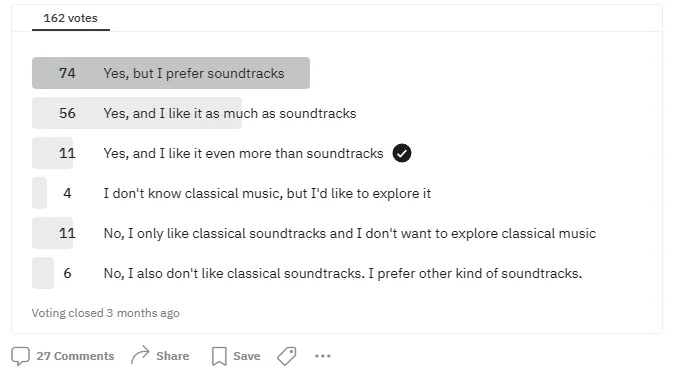
In the image here below you can see the results of a poll in the subreddit "soundtracks" (for people who love soundtracks), which asked "Do you like classical music outside of soundtracks?".
As you can see, the 87% of the voters (141 out of 162) like classical music in general. So, if you think that classical soundtracks are appreciated by people who hate classical music, it's simply a fantasy.
This simple fact also tell us that if John Williams is the most popular living composer it's because he is popular among people who like classical music, not because he is popular among hip-hop fans.
Of course there are casual listeners without any particular interest for classical music who hear a melody in a soundtrack and say "what a beautiful melody!", but this is true for classical music in general. A casual listener can also have a positive reaction to a Mozart's melody.
So, the data we see above tell us that people who like soundtracks like classical music, but it doesn't say nothing about how many people of the classical world enjoy soundtracks... but does it matter when it comes to determine if something is classical music or not?
Let's pretend that only the 1% of the classical listeners listen to the music of Otto Olsson. Does the impopularity of Otto Olsson tell us that his music is not classical, or does it simply tell us that he is not a popular artist?
Well, this is not the case of John Williams: he is less popular than Mozart, but he is also the most popular living composer, as the data shared by @Forster suggest.
I am trying to understand the meaning of your nickname: "Phil Classical Purist". What is "pure classical music?".
If it is only about subjective perception, I can simply tell you that the music of John Williams and other composers of soundtracks is the most classical product in the modern world, to my ears.
If it's about objective elements, are you able to provide them, so that we can determine with a machine if something is pure classical music or not?
I have the feeling that the machine would find more elements of classical music in John Williams' music than it would find in the music of other contemporary artists, whose music many here would label as 'pure classical music'.
I've also read the post of @Fluteman and it really deserves a double facepalm for the complete nonsense expressed in the text.
> Bachtrack can define music genres any way they wish, but it would be just as legitimate to call Paul McCartney, Elton John, Wynton Marsalis, David Byrne, Laurie Anderson, Thom Yorke, Madonna, and, yes, Taylor Swift classical composers as it is to call John Williams one.
No, because the music of John Williams has clear elements of classical music (so much that someone might even say that it's the most classical product in the modern society), while the music of the artists you listed doesn't.
Paul McCartney has composed some classical pieces and in that specific cases his music can be labeled as "classical".
Nothing is difficult here.
If John Williams composes rock music, it's rock.
If he composes classical music, it's classical music.
If Paul McCartney composed classical music, it's classical music.
If the composes rock music, it's rock.
What the fuck is wrong with you? It's strange that someone who says that musical categories are arbitrary and created for marketing reasons stresses so much the idea that the music of John Williams is not classical. To be marketing are your posts! Marketing for sellers of fried air!
To @SanAntone: no one thinks that to label the music of John Williams as "classical music" makes it automatically good music. If we wanted to push the idea the John Williams is the best composer, we would simply say that he is the best composer.
The question we all should ask ourselves is why many people, including yourself, want to exclude works with clear elements of classical music from classical music. If the answer to this question is 'for simple snobbish reasons,' I think we get very close to the truth.
"I am a cultured person because I listen to classical music!"
"Uhm... classical music? You mean that stuff from Hollywood movies? You don't seem that cultured!"
"Darn, I have to go around saying that Hollywood music isn't classical, otherwise people think I'm uncultured."
**Modificato dall'autore il 02.02.2024 19:13**
☺
Musica
Nel 2002 a vincere il premio Oscar "Best Original Score" fu il film Il Signore degli Anelli - La compagnia dell'Anello .
La musica è stata composta da Howard Shore.
Nel Classic FM Hall of Fame 2023, la colonna sonora del Signore degli Anelli è arrivata alle 35esima posizione (35 di 300).
In effetti questa colonna sonora è veramente bella! Apprezzo anche il coro di bambini e il bambino solista che sono stati utilizzati per la colonna sonora, dandogli quel tocco di nostalgica innocenza e dolcezza che solo la voce dei bambini può dare!
Ditemi cosa ne pensate del film e della musica.
Il video qui sotto, che contiene una selezione delle parti migliori della suite, è strutturato come segue:
00:00 The Breaking of the Fellowship [tema principale]
07:24 A Journey in the Dark
11:45 Concerning Hobbits
14:41 Flight to the Ford
18:56 The Great River
21:40 The Council of Elrond [ripresa finale del tema principale con climax]
VAI AL VIDEO VIMEO
Qui sotto il video di Howard Shore che si tuffa a testa sul palco per prendere la statuetta. Ha veramente rischiato di farsi male!
**Modificato dall'autore il 03.03.2024 19:12**
.La musica è stata composta da Howard Shore
. Nel Classic FM Hall of Fame 2023
, la colonna sonora del Signore degli Anelli è arrivata alle 35esima posizione (35 di 300).In effetti questa colonna sonora è veramente bella! Apprezzo anche il coro di bambini e il bambino solista che sono stati utilizzati per la colonna sonora, dandogli quel tocco di nostalgica innocenza e dolcezza che solo la voce dei bambini può dare!
Ditemi cosa ne pensate del film e della musica.
Il video qui sotto, che contiene una selezione delle parti migliori della suite, è strutturato come segue:
00:00 The Breaking of the Fellowship [tema principale]
07:24 A Journey in the Dark
11:45 Concerning Hobbits
14:41 Flight to the Ford
18:56 The Great River
21:40 The Council of Elrond [ripresa finale del tema principale con climax]
VAI AL VIDEO VIMEO
Qui sotto il video di Howard Shore che si tuffa a testa sul palco per prendere la statuetta. Ha veramente rischiato di farsi male!
**Modificato dall'autore il 03.03.2024 19:12**
☺
Musica
Ho ricevuto un'email da yoda@gmail.com con scritto: "Mattia, la musica da camera che posti mi rende triste. Puoi postare qualcosa di più vigoroso?".
Si... finalmente dopo tutta la montagna di pezzi da camera, arriva un pezzo orchestrale, ovvero un balletto che Beethoven ha composto nel 1801, all'età di 30 anni.
Anche Beethoven ha composto un balletto, non solo Tchaikovsky. Il titolo è "Le creature di Prometeo". Lo trovate nel video qui sotto (ma solo la musica, senza balletto).
Beethoven - Op. 43 - The Creatures of Prometheus (1801):
Overture - Adagio - Allegro molto e con brio
Introduction (La Tempesta). Allegro non troppo (5:02)
Act I
1. Poco Adagio (7:06)
2. Adagio - allegro con brio (10:24)
3. Minuetto (12:17)
Act II.
4. Maestoso - Andante (14:48)
5. Adagio - Andante quasi Allegretto (16:07)
6. Un poco Adagio - Allegro (23:08)
7. Grave (24:35)
8. Marcia. Allegro con brio - Presto (29:29)
9. Adagio - Allegro molto (36:38)
10. Pastorale. Allegro (40:47)
11. Coro di Gioja. Andante (43:52)
12. Maestoso (also known as "Solo di Gioia" for solo dancer Gaetano Gioia) (44:13)
13. Terzettino - Grotteschi. Allegro - Comodo (47:29)
14. Andante - Adagio (also known as "Solo della Casentini", written for Beethoven's prima ballerina Mademoiselle Casentini) (51:19)
15. Coro, Solo di Vigano. Andantino - Adagio - Allegro (56:24)
16. Finale. Allegretto - Allegro molto - Presto (1:00:57)
**Modificato dall'autore il 01.02.2024 18:25**
☺
Musica
Composto da Mozart nel 1784, all'età di 28 anni.
Mozart - K. 459 - Piano Concerto No. 19 in F major (1784):
I. Allegro [0:00]
II. Allegretto [12:41]
III. Allegro assai [20:41]
Mozart - K. 459 - Piano Concerto No. 19 in F major (1784):
I. Allegro [0:00]
II. Allegretto [12:41]
III. Allegro assai [20:41]
☺
Musica
Avevo già scritto qua e là che John Williams, così a occhio, doveva essere il compositore di musica classica più influente del nostro tempo, ma le mie considerazioni erano basate per lo più sulla percezione.
Ora sono venuto a conoscenza di dati statistici che confermano la mia percezione. I dati sono stati rilevati da Bachtrack, il più grande sito per cercare eventi di musica classica.
In questo PDF sono riportate varie statistiche concernenti l'anno 2023: https://cdn.bachtrack.com/files/350970-Annual%20cl...
Ora, se andate al capitolo "TOP COMPOSERS" potete leggere interessanti statistiche riguardanti il numero di eventi concertistici per ciascun compositore.
I compositori più suonati nel 2023 sono stati i seguenti (dal più popolare al meno popolare):
1. Mozart, W.A.
2. Beethoven, Ludwig van
3. Bach, Johann Sebastian
4. Brahms, Johannes
5. Schubert, Franz
6. Rachmaninov, Sergei
7. Tchaikovsky, Pyotr Ilyich
8. Strauss, Richard
9. Schumann, Robert
10. Ravel, Maurice
Tuutavia, se si restringe il campo ai compositori viventi, le classifiche sono queste (dal più popolare al meno popolare):
1. Williams, John
2. Pärt, Arvo
3. Widmann, Jörg
4. Adès, Thomas
5. Glass, Philip
6. Adams, John
7. Gubaidulina, Sofia
=8 Shaw, Caroline
=8 Chin, Unsuk
10. Clyne, Anna
Ora, se John Williams fosse rilevante solo in ambito cinematografico, allora la sua popolarità andrebbe considerata nel suo ambito specifico, ma non è questo quello che dicono le statistiche.
Le statistiche dicono che negli eventi CONCERTISTICI la musica di John Williams è stata quella più considerata nel 2023, quindi il compositore americano è sulla buona strada per diventare il compositore di musica classica più influente del nostro tempo.
**Modificato dall'autore il 01.02.2024 02:05**
Ora sono venuto a conoscenza di dati statistici che confermano la mia percezione. I dati sono stati rilevati da Bachtrack
, il più grande sito per cercare eventi di musica classica.In questo PDF sono riportate varie statistiche concernenti l'anno 2023: https://cdn.bachtrack.com/files/350970-Annual%20cl...
Ora, se andate al capitolo "TOP COMPOSERS" potete leggere interessanti statistiche riguardanti il numero di eventi concertistici per ciascun compositore.
I compositori più suonati nel 2023 sono stati i seguenti (dal più popolare al meno popolare):
1. Mozart, W.A.
2. Beethoven, Ludwig van
3. Bach, Johann Sebastian
4. Brahms, Johannes
5. Schubert, Franz
6. Rachmaninov, Sergei
7. Tchaikovsky, Pyotr Ilyich
8. Strauss, Richard
9. Schumann, Robert
10. Ravel, Maurice
Tuutavia, se si restringe il campo ai compositori viventi, le classifiche sono queste (dal più popolare al meno popolare):
1. Williams, John
2. Pärt, Arvo
3. Widmann, Jörg
4. Adès, Thomas
5. Glass, Philip
6. Adams, John
7. Gubaidulina, Sofia
=8 Shaw, Caroline
=8 Chin, Unsuk
10. Clyne, Anna
Ora, se John Williams fosse rilevante solo in ambito cinematografico, allora la sua popolarità andrebbe considerata nel suo ambito specifico, ma non è questo quello che dicono le statistiche.
Le statistiche dicono che negli eventi CONCERTISTICI la musica di John Williams è stata quella più considerata nel 2023, quindi il compositore americano è sulla buona strada per diventare il compositore di musica classica più influente del nostro tempo.
**Modificato dall'autore il 01.02.2024 02:05**
☺
Musica
Sinfonia No. 5, composta da Mozart nel 1765, all'età di 9 anni.
Mozart - K. 22 - Symphony No. 5 in B-flat major (1765):
00:00 I. Allegro, 4/4
02:39 II. Andante, 2/4
05:43 III. Allegro molto, 3/8
Mozart - K. 22 - Symphony No. 5 in B-flat major (1765):
00:00 I. Allegro, 4/4
02:39 II. Andante, 2/4
05:43 III. Allegro molto, 3/8