


Forum Deserto
Scritto da
Non Autenticato
il 2024-06-19 03:59:19.0 alle 2024-06-19 03:59:19.0
> Una lista delle principali AI
>
> https://www.aixploria.com/en/ultimate-list-ai/
Peccato non abbia tempo per giocarci, perché diventare esperto nell'uso delle ia costituirebbe un bel vantaggio.
Queste intelligenze artificiali rappresentano un bel passo in avanti che introduce una divisione fra un prima e un dopo, come internet, i cellulari, i quadricotteri...
Sarebbe già qualcosa sapere quali non richiedono un'iscrizione.
☺
Forum Deserto
I opened the discussion "Why do many people think that classical music composed for film scores is not classical music" and after a while I was permanently banned from the discussion, and from the entire forum for 7 days, only because I wrote that people like @mikeh375 apply double standards in classification.
Now, I'll repeat the censored truths:
1) Many soundtracks are based on classical music, and so they ARE classical music
2) mikeh375 uses double standards in classification.
In the same discussion there were composers who heavily attacked Hans Zimmer, but if you compare this film score...
... with this other one...
... it's not difficult to understand why Hans Zimmer is well regarded as a film composer.
These are simple truths, and truths must NEVER be censored.
I wrote that "Antigone" of Mendelssohn is an example of a classical soundtrack and I was banned for 40 days.
Now I'll repeat the truth: classical soundtracks and incidental music are basically the same thing.
The categories are as you see in the picture here below.
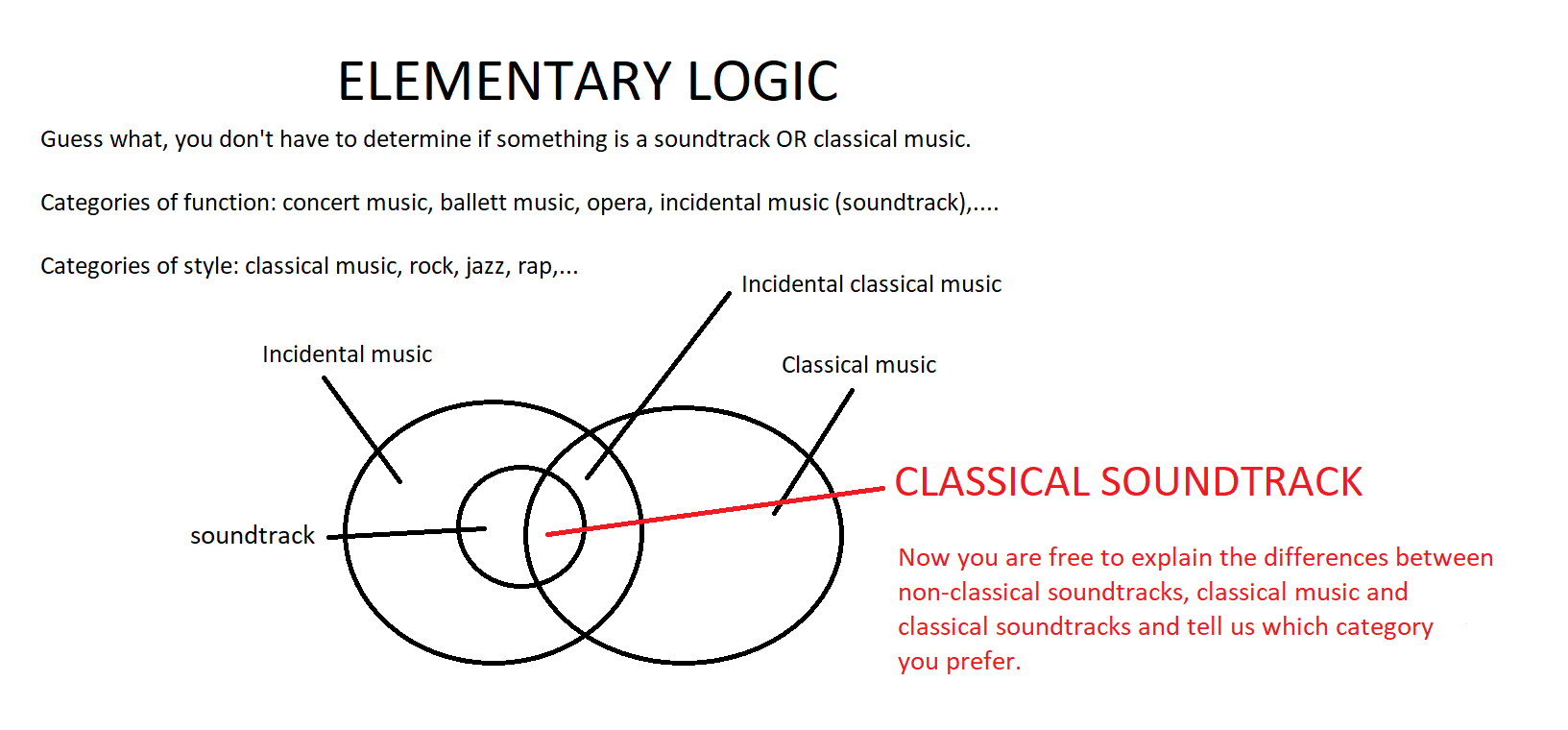

This is the simple truth, and truth must never be censored.
I wrote that Elisey Mysin is attractive and my post was deleted.
After a while, the moderators read in an other forum that I am attracted to little boys and they decided to permanently ban me from the forum.
In this case it's not censorship. It's even worse: it's DISCRIMINATION. They should be legally persecuted for this.
However, right now I'll tell you that the most attractive classical musicians I know are Adam and Mate. I think that @Shaughnessy will be happy to know this.
This is the simple truth, and the truth must never be censored. Even if you censor my posts, I will still think that little boys are extremely attractive.
I'll return here regularily to remember the truth.
**Modificato dall'autore il 09.06.2024 16:23**
Now, I'll repeat the censored truths:
1) Many soundtracks are based on classical music, and so they ARE classical music
2) mikeh375 uses double standards in classification.
In the same discussion there were composers who heavily attacked Hans Zimmer, but if you compare this film score...
... with this other one...
... it's not difficult to understand why Hans Zimmer is well regarded as a film composer.
These are simple truths, and truths must NEVER be censored.
I wrote that "Antigone" of Mendelssohn is an example of a classical soundtrack and I was banned for 40 days.
Now I'll repeat the truth: classical soundtracks and incidental music are basically the same thing.
The categories are as you see in the picture here below.

This is the simple truth, and truth must never be censored.
I wrote that Elisey Mysin is attractive and my post was deleted.
After a while, the moderators read in an other forum that I am attracted to little boys and they decided to permanently ban me from the forum.
In this case it's not censorship. It's even worse: it's DISCRIMINATION. They should be legally persecuted for this.
However, right now I'll tell you that the most attractive classical musicians I know are Adam and Mate. I think that @Shaughnessy will be happy to know this.
This is the simple truth, and the truth must never be censored. Even if you censor my posts, I will still think that little boys are extremely attractive.
I'll return here regularily to remember the truth.
**Modificato dall'autore il 09.06.2024 16:23**
Forum Deserto
Scritto da
Non Autenticato
il 2024-06-01 17:07:53.0 alle 2024-06-01 17:07:53.0
Scritto da:
> Ma io scherzavo :/
>
> Nemmeno i bimbi di 8 anni si fanno fare i riassunti.
> La sua è solo lercia pigrizia.
... o lercia incapacità di scrivere un semplice riassunto. Roba che fanno fare alle elementari.
Per fortuna che esiste l'intelligenza artificiale, così fare le elementari non è più necessario.
Forum Deserto
Scritto da
Non Autenticato
il 2024-05-31 13:00:43.0 alle 2024-05-31 13:00:43.0
> Fai un riassunto che gattaggio è spompo.
>
>

Gattaggio ha da fare, e poco tempo.
>
>
Gattaggio ha da fare, e poco tempo.
Arricchimento culturale in Svezia in corso
Ad
https://www.breitbart.com/europe/2019/01/04/patient-placed-in-quarantine-after-suspected-ebola-case-in-sweden/
The Emergency Room of a Swedish hospital was closed down Friday morning after a patient recently returned from Africa arrived vomiting blood, a possible symptom of the deadly and contagious Ebola virus.
Forum Deserto
Scritto da
Non Autenticato
il 2024-05-31 12:45:33.0 alle 2024-05-31 12:45:33.0
Ma io scherzavo :/
Nemmeno i bimbi di 8 anni si fanno fare i riassunti.
La sua è solo lercia pigrizia.
Nemmeno i bimbi di 8 anni si fanno fare i riassunti.
La sua è solo lercia pigrizia.
☺
Forum Deserto
Scritto da:
> Fai un riassunto che gattaggio è spompo.
>
>
Ho fatto fare un riassunto da Open AI.
-----------------
Introduzione
La self-ownership è il principio per cui ogni cittadino è proprietario di sé stesso, del proprio corpo e della propria vita. Questo concetto è centrale nella teoria politica e ci permette di comprendere tre punti fondamentali:
- Perché la self-ownership è un diritto?
- Perché la proprietà privata e il libero mercato non esistono senza la self-ownership?
- Perché tutti i diritti negativi degli esseri umani discendono dalla self-ownership?
Fondamenti Etici
Prima di approfondire la self-ownership come diritto, è essenziale stabilire le basi dell'etica. L'etica è rilevante solo per gli esseri umani, che hanno interesse a creare una società che massimizzi la loro felicità. Pertanto, una legge giusta deve mirare a creare una società che ottimizzi la felicità umana. Questo principio, una volta accettato, porta logicamente alla self-ownership come diritto fondamentale.
Perché la self-ownership è un diritto?
Ogni persona ha PER NATURA il possesso del proprio corpo e della propria vita, cioè esiste attraverso di essi. Se abbiamo il possesso naturale del nostro corpo e della nostra vita, è logico che dobbiamo essere anche i proprietari (cioè, coloro che possono prendere decisioni a riguardo). Nessun altro ha un diritto maggiore di essere proprietario del nostro corpo.
Perché mai una persona che non potrà mai indossare il nostro corpo, la nostra vita e le nostre emozioni dovrebbe avere più diritto di noi a prendere decisioni in merito?
Effetti benefici della self-ownership
La felicità umana è la somma delle felicità individuali. Se attribuiamo a ogni individuo felice un punteggio di +1 e a ogni individuo infelice un punteggio di -1, la massima felicità complessiva di un gruppo di 20 persone è +20. Per ottenere il punteggio complessivo massimo, è necessario che ogni individuo possa agire liberamente secondo le proprie preferenze. Questo richiede che ogni persona sia proprietaria di sé stessa.
Esempio Pratico: Il Ristorante
Immaginiamo un gruppo di 20 persone in un ristorante. Se tutti dovessero mangiare uno stesso piatto scelto democraticamente, alcuni sarebbero soddisfatti di quello che arriva in tavola, altri no. Per massimizzare la felicità di tutti, ognuno deve poter scegliere il proprio piatto. Questa libertà di scelta è possibile solo se ogni individuo è proprietario di sé stesso, ovvero se gode della self-ownership.
Obiezioni e Controargomentazioni
Qualcuno potrebbe obiettare che persone con capacità limitate di intendere e volere potrebbero prendere decisioni dannose per sé stesse, ma questo controargomento non può essere accettato perché si tratta di casi particolari.
L'esempio di Alan Turing, processato per atti omosessuali, dimostra che l'assenza di self-ownership si traduce nel fatto che persone meno intelligenti di te stabiliscono cosa puoi o non puoi fare della tua vita e del tuo corpo.
Va ricordato infatti che nella democrazia non esiste nessun meccanismo per assicurare chi chi va al potere sia dotato di particolare intelligenza.
Proprietà Privata e Libero Mercato
La self-ownership è la base della proprietà privata, in quanto un oggetto è tuo per via del fatto che l'hai realizzato con le tue mani. Per poter scambiare beni e servizi liberamente, dobbiamo essere proprietari di ciò che produciamo con il nostro lavoro. Senza la self-ownership, lo stato potrebbe reclamare la proprietà di tutto ciò che produciamo (infatti se le tue mani appartengono allo stato, allora ciò che produci con esse appartiene allo stato), eliminando di fatto la proprietà privata e il libero mercato.
Ecco perché di tutte le possibili posizioni politiche, quella fascistoide ma in favore del libero mercato è quella più ridicola: se un individuo non è nemmeno proprietario di sé stesso, come può essere proprietario di oggetti esterni al proprio corpo e quindi poter scambiare liberamente gli oggetti in suo possesso?
Libero Mercato dei Servizi
Nel mercato dei servizi, una persona mette sostanzialmente le proprie mani a disposizione di un'altra persona, perciò il libero mercato dei servizi è direttamente legato alla self-ownership senza passare per la proprietà privata. Se le tue mani non ti appartengono, come puoi offrire liberamente i tuoi servizi? Se lo stato è il proprietario delle tue mani, allora non solo i ricavi dei servizi da te offerti spettano interamente a lui (poi ti può lasciare una piccola fetta di quello che il cliente paga), ma spetta a lui decidere quando, dove e come puoi offrire servizi.
Diritti Negativi e Self-Ownership
Tutti i diritti negativi (diritti a non essere interferiti) derivano dalla self-ownership o dalla proprietà privata (che a sua volta deriva dalla self-ownership). Lo stato non ti può uccidere perché la tua vita ti appartiene, non può distruggere la tua automobile perché ti appartiene, non può reprimere la tua libertà di pensiero perché il tuo cervello ti appartiene.
Una volta caduto il principio della self-ownership e il principio che da esso deriva, ovvero la proprietà privata degli oggetti esterni al proprio corpo realizzati con il proprio lavoro, tutto quanto appartiene allo stato e ogni libertà individuale è solo una sua gentile concessione che può essere revocata dall'oggi al domani.
Conclusione
Negare la self-ownership significa negare potenzialmente tutti i diritti, pertanto il non riconoscimento della self-ownership da parte di uno stato è fondamentalmente il preludio della dittatura e del totalitarismo.
Tanto più lo stato calpesta la self-ownership, tanto più si viene a giustificare moralmente una nostra reazione anche con l'uso delle armi.
Reagire alla violenza dello stato con la violenza non va considerato come un atto moralmente criminale, ma come un atto di legittima difesa.
**Modificato dall'autore il 31.05.2024 13:02**
Forum Deserto
Scritto da
Non Autenticato
il 2024-05-31 10:41:57.0 alle 2024-05-31 10:41:57.0
Fai un riassunto che gattaggio è spompo.
Forum Deserto
Scritto da
Non Autenticato
il 2024-05-30 20:02:52.0 alle 2024-05-30 20:02:52.0
Scritto da:
> > Utile
> >
> > https://snapdrop.net/
> >
> > Per spostare file da cellulare a pc tramite Wi-fi. Utile per grossi file.
> > Veloce ed intuitivo.
>
> Non è affatto intuitivo, sulla pagina non c'è niente da cliccare.

Gattaccio pigraccio
> > Utile
> >
> > https://snapdrop.net/
> >
> > Per spostare file da cellulare a pc tramite Wi-fi. Utile per grossi file.
> > Veloce ed intuitivo.
>
> Non è affatto intuitivo, sulla pagina non c'è niente da cliccare.
Gattaccio pigraccio
Immacolata concezione
Ad
http://archive.vn/qN1x1
Meglio della Madonna! Se vuoi scoprire come ha fatto clicca qui!!
Forum Deserto
Scritto da
Non Autenticato
il 2024-05-30 19:24:16.0 alle 2024-05-30 19:24:16.0
> Utile
>
> https://snapdrop.net/
>
> Per spostare file da cellulare a pc tramite Wi-fi. Utile per grossi file.
> Veloce ed intuitivo.
Non è affatto intuitivo, sulla pagina non c'è niente da cliccare.
>
> https://snapdrop.net/
>
> Per spostare file da cellulare a pc tramite Wi-fi. Utile per grossi file.
> Veloce ed intuitivo.
Non è affatto intuitivo, sulla pagina non c'è niente da cliccare.
Forum Deserto
Scritto da
Non Autenticato
il 2024-05-30 15:43:58.0 alle 2024-05-30 15:43:58.0
Utile
https://snapdrop.net/
Per spostare file da cellulare a pc tramite Wi-fi. Utile per grossi file.
Veloce ed intuitivo.
https://snapdrop.net/
Per spostare file da cellulare a pc tramite Wi-fi. Utile per grossi file.
Veloce ed intuitivo.
Forum Deserto
Scritto da
Non Autenticato
il 2024-05-30 15:01:38.0 alle 2024-05-30 15:01:38.0
Scritto da:
> Scritto da:
> > Scritto da: Mattia
> > > Scritto da:
> > > > Cos'è sto muro di teoria? Qualcuno dovrebbe leggerlo?
> > >
> > > Si, dovrebbe! Non vedo che problemi crei la lunghezza: i libri di filosofia sono molto più lunghi di così. Se poi uno è troppo pigro per leggersi testi lunghi allora è condannato a diventare un asino, perché con tre righe di testo si può solo produrre un'argomentazione superficiale.
> >
> > È il gattaccio che dopo un po' è "spompo"
>
> asinaggio selvaggio
Tu l'hai letto? Dimostralo scrivendo un riassunto
Forum Deserto
Scritto da
Non Autenticato
il 2024-05-30 12:42:48.0 alle 2024-05-30 12:42:48.0
Scritto da:
> Scritto da: Mattia
> > Scritto da:
> > > Cos'è sto muro di teoria? Qualcuno dovrebbe leggerlo?
> >
> > Si, dovrebbe! Non vedo che problemi crei la lunghezza: i libri di filosofia sono molto più lunghi di così. Se poi uno è troppo pigro per leggersi testi lunghi allora è condannato a diventare un asino, perché con tre righe di testo si può solo produrre un'argomentazione superficiale.
>
> È il gattaccio che dopo un po' è "spompo"
asinaggio selvaggio
Partecipa anche tu!
Ad
https://bit.ly/2RsJ87Z
La rivoluzione è dietro l'angolo, compagno! Non fare il gatto selvaggio, unisciti al nostro plotone!
Forum Deserto
Scritto da
Non Autenticato
il 2024-05-30 12:13:01.0 alle 2024-05-30 12:13:01.0
Scritto da: Mattia
> Scritto da:
> > Cos'è sto muro di teoria? Qualcuno dovrebbe leggerlo?
>
> Si, dovrebbe! Non vedo che problemi crei la lunghezza: i libri di filosofia sono molto più lunghi di così. Se poi uno è troppo pigro per leggersi testi lunghi allora è condannato a diventare un asino, perché con tre righe di testo si può solo produrre un'argomentazione superficiale.
È il gattaccio che dopo un po' è "spompo"
☺
Forum Deserto
Scritto da:
> Cos'è sto muro di teoria? Qualcuno dovrebbe leggerlo?
Si, dovrebbe! Non vedo che problemi crei la lunghezza: i libri di filosofia sono molto più lunghi di così. Se poi uno è troppo pigro per leggersi testi lunghi allora è condannato a diventare un asino, perché con tre righe di testo si può solo produrre un'argomentazione superficiale.
Forum Deserto
Scritto da
Non Autenticato
il 2024-05-30 03:32:17.0 alle 2024-05-30 03:32:17.0
Scritto da: Mattia
> The self-ownership: the fundamental right from which all citizens' negative rights derive
>
> Self-ownership is the principle that individuals are the owners of themselves, their body, and their life.
>
> In this post, we will try to understand three fundamental things for political theory:
>
> - Why is the self-ownership a right?
>
> - Why can't private property and the free market exist without the self-ownership
>
> - Why do all negative human rights stem from self-ownership?
>
>
> Introduction: the fundamental basis of ethics
>
> Before understanding why self-ownership is a right, we must first lay the foundations of ethics.
>
> Let's start by saying that ethics is functional to human beings: the universe, space-time, matter, etc., do not care about ethics. It is something that concerns humans, who for obvious reasons have an interest in creating a world that allows them to be happy.
>
> Given this premise, the fundamental basis of ethics must logically be the following: "Laws are meant to create a society that maximizes human happiness." Of course, this is a subjective matter: someone could argue that the purpose should be to destroy humanity, but making such a declaration would be equivalent to declaring war on humanity. Therefore, anyone who supports this cannot complain if humans do everything possible to thwart them: it's simple self-defense!
>
> I believe, however, that this principle is shared by most people, and once accepted, self-ownership is simply a logical consequence.
>
>
>
> Why is the self-ownership a right?
>
> What is human happiness, if not the sum of the happiness of individual people?
>
> Putting the issue in mathematical terms: we assign a score of +1 to each happy person, a score of -1 to each unhappy person, and a score of 0 to each person who is neither particularly happy nor particularly unhappy.
>
> If a given country has 10,000 inhabitants, what is the maximum possible score for human happiness? Obviously: +10,000, which is obtained if every single inhabitant has a happiness score of +1. Conversely, the lowest possible score is -10,000, which is obtained if every single inhabitant has a happiness score of -1.
>
> Once we understand that "social happiness" is nothing more than the sum of individual happiness, we can focus on individual happiness.
>
> Now, let's say we are 20 people in a restaurant. If we order the same menu for everyone, some people will be happy with what arrives at the table, others less so, and others not at all. For example, if we order roast meat for everyone, vegetarians will be out of luck. To ensure everyone is happy with what arrives on their plate, it is necessary for each person to order their meal individually. If everyone receives exactly what they want to eat, then each person's happiness score will be +1, and the overall score will reach the maximum: +20.
>
> The most astute among you should have already grasped the conclusion of this simple observation: for each person to order their own meal, it is necessary that each of us is the owner of ourselves, our body, and our life. In other words, it is necessary that each of us has the self-ownership.
>
> Indeed, if an individual is not the owner of himself, but instead belongs to someone else, then his master must approve his order. If he belongs to the state, then the state must approve it. Only if the individual is the owner of himself he doesn't need to ask anyone's permission to order what he desires. Is it clear?
>
> Now, someone might argue that if a person is barely capable of making sound decisions, their choices might inadvertently harm themselves. In fact, the state provides for the assignment of a guardian to mentally impaired individuals, but these are exceptional cases. Neo-fascists would want to revoke self-ownership from people much smarter than they are. Take Alan Turing, for example: his intelligence was superior to that of all the pathetic neo-fascists in the world combined, yet the state arrested him for homosexual acts. That is, people less intelligent than him decided that he could not do XY with his body. This is why I will reject any such argument: using the case of mentally impaired individuals to counter my argument would be intellectually dishonest!
>
> That said, the guardian assigned to mentally impaired people should aim to GUIDE the person, not to exercise a tyrannical power over them like a master over a slave. In fact, if a guardian treated the person like a slave, the state should remove him from his position. Thus, even these people are not completely stripped of self-ownership: the guardian must still try to guide them in the pursuit of their happiness.
>
> In the previous paragraphs, we understood why self-ownership is necessary to maximize human happiness, but there is also a very simple logical argument that justifies self-ownership.
>
> It is inevitable that someone owns our body, right? Someone always makes decisions about it in any system. If we are not the owners, then someone else is, correct?
>
> Now, why should other people or institutions be the owners of our body and not ourselves? Each of us has, BY NATURE, POSSESSION of our own body, right? This is something that no one can take away from us! If we have POSSESSION of our body and our life, then why shouldn't we also be its owner? In other words, based on what element would a person who does not have the NATURAL POSSESSION of our body and our life have more right than we do to be its OWNER?
>
> Well, I would say the question is quite obvious: no, no human being has more right to be the owner of our body than we do, so it is right that each person be the owner of himself. That is, it is right that every person has the self-ownership.
>
>
>
> Why can't private property and the free market exist without the self-ownership
>
> The free market is the right that allows people to freely exchange goods and services among themselves.
>
> It is obvious that to freely exchange the goods you own, you must be their owner, so the free market cannot exist without private property.
>
> In turn, NATURAL private property is justified by self-ownership. In fact, what is the ethical element that makes a person the NATURAL owner of a good? Very simply: he produced the good with his own hands. It is clear that if our hands did not belong to us, but instead to the state, then the state would be the owner of everything we produce, so private property would not exist. Consequently, neither would the free market.
>
> In the previous paragraphs, we focused on the free market of goods, but let's talk about the free market of services. In this case, the good is not an object, but a person, essentially. A person who makes their hands available for you. The free market of services therefore derives directly from the self-ownership without even passing through private property. In fact, how can the caregiver Svetlana be free to offer you the service of changing your diaper with her hands if her hands do not belong to her? She would have to ask the state for permission to do so. The state could not only say "no, you can't do it," but it could also say: "Yes, you can do it, but only if your client pays the state for your service, not you... since we are the owners of your hands!". So the state pockets 10 euros per hour, then in turn gives 3 euros per hour to Svetlana.
>
> This is why of all political positions, the most idiotic one is that of fascist-like people who are against self-ownership but in favor of the free market. How the hell can a person be the owner of material goods if they are not even the owner of their own body? How can a person freely make their body available to others if they are not the owner of their own body?
>
>
>
> Why do all negative human rights stem from self-ownership?
>
> The answer to this question is easy: all negative rights stem either directly from self-ownership or from private property (which in turn stems from self-ownership).
>
> Why can't the state kill me? Because since I am the owner of my life, only I can destroy it: others cannot!
>
> Why can't the state destroy my car or any other object I own? Because they are mine, so only I can destroy them: the state cannot.
>
> Why am I free to think whatever I want? Because my brain is my property, not the state's!
>
> And so on...
>
> The logical consequence of throwing self-ownership in the trash is to throw all rights in the trash. ALL OF THEM, FROM THE FIRST TO THE LAST! IS IT CLEAR?? This is why we have the moral right to defend ourselves, even with weapons, against anyone who wants to take away our self-ownership!
>
>
> **Modificato dall'autore il 29.05.2024 14:22**
Cos'è sto muro di teoria? Qualcuno dovrebbe leggerlo?
☺
Forum Deserto
The self-ownership: the fundamental right from which all citizens' negative rights derive
Self-ownership is the principle that individuals are the owners of themselves, their body, and their life.
In this post, we will try to understand three fundamental things for political theory:
- Why is the self-ownership a right?
- Why can't private property and the free market exist without the self-ownership
- Why do all negative human rights stem from self-ownership?
Introduction: the fundamental basis of ethics
Before understanding why self-ownership is a right, we must first lay the foundations of ethics.
Let's start by saying that ethics is functional to human beings: the universe, space-time, matter, etc., do not care about ethics. It is something that concerns humans, who for obvious reasons have an interest in creating a world that allows them to be happy.
Given this premise, the fundamental basis of ethics must logically be the following: "Laws are meant to create a society that maximizes human happiness." Of course, this is a subjective matter: someone could argue that the purpose should be to destroy humanity, but making such a declaration would be equivalent to declaring war on humanity. Therefore, anyone who supports this cannot complain if humans do everything possible to thwart them: it's simple self-defense!
I believe, however, that this principle is shared by most people, and once accepted, self-ownership is simply a logical consequence.
Why is the self-ownership a right?
What is human happiness, if not the sum of the happiness of individual people?
Putting the issue in mathematical terms: we assign a score of +1 to each happy person, a score of -1 to each unhappy person, and a score of 0 to each person who is neither particularly happy nor particularly unhappy.
If a given country has 10,000 inhabitants, what is the maximum possible score for human happiness? Obviously: +10,000, which is obtained if every single inhabitant has a happiness score of +1. Conversely, the lowest possible score is -10,000, which is obtained if every single inhabitant has a happiness score of -1.
Once we understand that "social happiness" is nothing more than the sum of individual happiness, we can focus on individual happiness.
Now, let's say we are 20 people in a restaurant. If we order the same menu for everyone, some people will be happy with what arrives at the table, others less so, and others not at all. For example, if we order roast meat for everyone, vegetarians will be out of luck. To ensure everyone is happy with what arrives on their plate, it is necessary for each person to order their meal individually. If everyone receives exactly what they want to eat, then each person's happiness score will be +1, and the overall score will reach the maximum: +20.
The most astute among you should have already grasped the conclusion of this simple observation: for each person to order their own meal, it is necessary that each of us is the owner of ourselves, our body, and our life. In other words, it is necessary that each of us has the self-ownership.
Indeed, if an individual is not the owner of himself, but instead belongs to someone else, then his master must approve his order. If he belongs to the state, then the state must approve it. Only if the individual is the owner of himself he doesn't need to ask anyone's permission to order what he desires. Is it clear?
Now, someone might argue that if a person is barely capable of making sound decisions, their choices might inadvertently harm themselves. In fact, the state provides for the assignment of a guardian to mentally impaired individuals, but these are exceptional cases. Neo-fascists would want to revoke self-ownership from people much smarter than they are. Take Alan Turing, for example: his intelligence was superior to that of all the pathetic neo-fascists in the world combined, yet the state arrested him for homosexual acts. That is, people less intelligent than him decided that he could not do XY with his body. This is why I will reject any such argument: using the case of mentally impaired individuals to counter my argument would be intellectually dishonest!
That said, the guardian assigned to mentally impaired people should aim to GUIDE the person, not to exercise a tyrannical power over them like a master over a slave. In fact, if a guardian treated the person like a slave, the state should remove him from his position. Thus, even these people are not completely stripped of self-ownership: the guardian must still try to guide them in the pursuit of their happiness.
In the previous paragraphs, we understood why self-ownership is necessary to maximize human happiness, but there is also a very simple logical argument that justifies self-ownership.
It is inevitable that someone owns our body, right? Someone always makes decisions about it in any system. If we are not the owners, then someone else is, correct?
Now, why should other people or institutions be the owners of our body and not ourselves? Each of us has, BY NATURE, POSSESSION of our own body, right? This is something that no one can take away from us! If we have POSSESSION of our body and our life, then why shouldn't we also be its owner? In other words, based on what element would a person who does not have the NATURAL POSSESSION of our body and our life have more right than we do to be its OWNER?
Well, I would say the question is quite obvious: no, no human being has more right to be the owner of our body than we do, so it is right that each person be the owner of himself. That is, it is right that every person has the self-ownership.
Why can't private property and the free market exist without the self-ownership
The free market is the right that allows people to freely exchange goods and services among themselves.
It is obvious that to freely exchange the goods you own, you must be their owner, so the free market cannot exist without private property.
In turn, NATURAL private property is justified by self-ownership. In fact, what is the ethical element that makes a person the NATURAL owner of a good? Very simply: he produced the good with his own hands. It is clear that if our hands did not belong to us, but instead to the state, then the state would be the owner of everything we produce, so private property would not exist. Consequently, neither would the free market.
In the previous paragraphs, we focused on the free market of goods, but let's talk about the free market of services. In this case, the good is not an object, but a person, essentially. A person who makes their hands available for you. The free market of services therefore derives directly from the self-ownership without even passing through private property. In fact, how can the caregiver Svetlana be free to offer you the service of changing your diaper with her hands if her hands do not belong to her? She would have to ask the state for permission to do so. The state could not only say "no, you can't do it," but it could also say: "Yes, you can do it, but only if your client pays the state for your service, not you... since we are the owners of your hands!". So the state pockets 10 euros per hour, then in turn gives 3 euros per hour to Svetlana.
This is why of all political positions, the most idiotic one is that of fascist-like people who are against self-ownership but in favor of the free market. How the hell can a person be the owner of material goods if they are not even the owner of their own body? How can a person freely make their body available to others if they are not the owner of their own body?
Why do all negative human rights stem from self-ownership?
The answer to this question is easy: all negative rights stem either directly from self-ownership or from private property (which in turn stems from self-ownership).
Why can't the state kill me? Because since I am the owner of my life, only I can destroy it: others cannot!
Why can't the state destroy my car or any other object I own? Because they are mine, so only I can destroy them: the state cannot.
Why am I free to think whatever I want? Because my brain is my property, not the state's!
And so on...
The logical consequence of throwing self-ownership in the trash is to throw all rights in the trash. ALL OF THEM, FROM THE FIRST TO THE LAST! IS IT CLEAR? This is why we have the moral right to defend ourselves, even with weapons, against anyone who wants to take away our self-ownership!
**Modificato dall'autore il 30.05.2024 11:07**
AH SI ma NO Non lo so
Ad
http://sallo.it
LO SAI? Allora NON fa per te. NON LO SAI? Allora non ti serve.
☺
Forum Deserto
Scritto da
Alessandrox
(XYZ)Troll
il 2024-01-01 13:56:33.0 alle 2024-01-01 13:56:33.0
Trollate totali: 11553
Lo stoicismo non insegna a non reagire e solo sopportare passivamente ma a reagire nel modo più efficace ed efficiente possibile: se qualche evento può essere controllato, lo sarà nel miglior modo possibile. Se non può esesserlo, evita di sprecare energie in tentativi inutili
Scritto da:
> Scritto da: Alessandrox
> > Scritto da:
> > > Scritto da: Alessandrox
> > > >
> > > >
> > > > **Modificato dall'autore il 29.12.2023 22:29**
> > >
> > > Solita psicologia di bassa lega adatta agli yodi calvi.
> >
> > È filosofia.
> >
> > E quale sarebbe la psicologia "di alta lega"?
>
> All’interno della filosofia stoica, uno dei principi centrali è che la nostra pace interiore, felicità e tranquillità devono essere costruite su basi che non dipendano da ciò che gli altri dicono o fanno.
>
> La felicità dipende da condizioni oggettive su cui gli altri possono influire anche in modo determinante. Possono farti del male, e spesso non puoi farci niente né fisicamente sopportarlo: questo aspetto dello stoicismo non mi ha mai convinto e lo trovo irritante, come gli analoghi nelle filsofie orientali e in ogni filosofia dell'acquietamento.
.
> Forse il troll intendeva sottolineare questo, ma ha peccato di eccessiva sintesi.
Dunque: si e no. Dipende.
Dal tipo di aggressione e di danno.
Ma quand'anche fossero danni irreparabili (se sono riparabili, il problema non si pone o solo in modo abbastanza marginale) lo stoicismo ti fornisce gli strumenti mentali per reagire nel mondo più efficiente ed efficace possibile, perché evita le inutili dispersioni di energia dovute all'eccesso di emotività, insegna invece a reagire con freddezza, calcolo e ponderazione, mantenendo la massima determinazione.
**Modificato dall'autore il 01.01.2024 13:58**
Ma smettila di secernere cazzate!
Forum Deserto
Scritto da
Non Autenticato
il 2023-12-30 20:09:26.0 alle 2023-12-30 20:09:26.0
Scritto da: Alessandrox
> Scritto da:
> > Scritto da: Alessandrox
> > >
> > >
> > > **Modificato dall'autore il 29.12.2023 22:29**
> >
> > Solita psicologia di bassa lega adatta agli yodi calvi.
>
> È filosofia.
>
> E quale sarebbe la psicologia "di alta lega"?
All’interno della filosofia stoica, uno dei principi centrali è che la nostra pace interiore, felicità e tranquillità devono essere costruite su basi che non dipendano da ciò che gli altri dicono o fanno.
La felicità dipende da condizioni oggettive su cui gli altri possono influire anche in modo determinante. Possono farti del male, e spesso non puoi farci niente né fisicamente sopportarlo: questo aspetto dello stoicismo non mi ha mai convinto e lo trovo irritante, come gli analoghi nelle filsofie orientali e in ogni filosofia dell'acquietamento.
Forse il troll intendeva sottolineare questo, ma ha peccato di eccessiva sintesi.
Forum Deserto
Scritto da
Non Autenticato
il 2023-12-30 18:56:43.0 alle 2023-12-30 18:56:43.0
Scritto da: Alessandrox
> Scritto da:
> > Scritto da: Alessandrox
> > >
> > >
> > > **Modificato dall'autore il 29.12.2023 22:29**
> >
> > Solita psicologia di bassa lega adatta agli yodi calvi.
>
> È filosofia.
Ah ecco, chissà se al liceo insegnano anche ingegneria sociale. E' filosofia anche quella no?
>
> E quale sarebbe la psicologia "di alta lega"?
Di certo non i proverbi del tipo "non ti curar di loro ma guarda e passa", oppure come exploitare i comportamenti e gli errori degli altri in tuo favore.